|
What
is the right daylily for my garden?
To find the
answer to this question, you must know yourself and your
reason for growing daylilies. New gardeners tend to focus
exclusively on the daylily bloom. With experience comes
discretion. Tastes develop and garden requirements surface.
Here are some questions you should ask yourself before
making a daylily purchase.
- Is
the flower sunfast or does it fade in the hot sun?
- Does
the cultivar rebloom?
- Does
the cultivar exhibit extended blooming habits, or does
it finish blooming by early spring?
- Are
the scapes low, medium, or tall?
- What
about branching?
- Is
this my kind of flower?

What
performance characteristics should I look for in a daylily?
When purchasing
a daylily, consider foliage, vigor and stamina, scapes,
branching and buds, and flower substance.
- Foliage
- Variation
in foliage is important for contrast in color and texture
in the total garden picture. Consider the following:
- Foliage
is best judged when you are not unduly influenced
by the beauty of flower.
- Foliage
must have an attractive appearance.
- Foliage
should be of a type that is compatible with your
climate.
- Vigor
and Stamina
- As to vigor
and stamina, the daylily plant should:
- Have
the ability to grow and multiply under good conditions
without being invasive of adjacent areas by underground
rhizomes.
- Establish
quickly, thrive, and grow stronger each year.
- Be
easy to transplant.
- Not
be susceptible to crown rot or spring sickness.
- Scapes
- Scapes
should have the following qualities:
- The
scape must have adequate strength to support
the buds and flowers (i.e., you should not have
to stake the scape because of wind, rain, or
directional light).
- The
height of the scape and the size of the flower
should be in good proportion to the thickness
of the scape.
- Branching
and Buds
- When evaluating
branching and buds on daylilies, remember the following:
- The
scape should branch so that the buds are not
all at the top of the scape.
- Flowers
should not open all together or be poorly spaced.
- Branches
should be wide apart to allow buds to develop
normally without touching and hampering the opening
of the fully developed flower.
- Branching
and bud count should not be so sparse that flowering
ends after a few days.
- Balance
- Good balance
means that the overall daylily plant has a pleasing
relationship between the foliage and the placement
of branches, buds, and flowers. Remember:
- Short
foliage and tall scapes with scant high branching
often appear poorly balanced.
- Emphasis
should be placed on how the scape relates to
the rest of the plant, regardless of height.
- Flower
Substance
- Flower
substance is very important when selecting your daylily.
Consider the following:
- Flower
tissue should not be thin, and should not wilt,
brown, or melt at the edges.
- If
the flower fades during the day, substance should
be retained reasonably well.
- A
flower that opens early in the morning should
remain presentable in the evening.
- Flower
Color
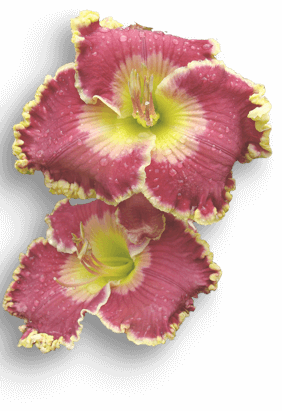
- Color has
a strong emotional appeal. Consider the following:
- Most
people find merit in colors that are clear, bright,
soft, vibrant, distinctive, and pleasingly blended.
Well-defined markings can add much to the beauty
of a flower.
- Murky,
dingy, streaked, dull, and faded colors can seldom
be considered an asset. Irregular markings are
usually considered a flaw, but a few hybridizers are working with spots and streaks and getting some interesting results.
- Llike many things, some colors and patterns are currently popular, and something new is always being looked for and pursued. For instance, getting bands of color within eyes or green on petal edges are currently areas of interest.
-
Flower
Form
- Flower
form, along with color, sets one flower apart from
another.
- Many
variations in form are favored equally by many
daylily collectors; a particular form is favored
by others.
- Malformed
flowers, dissimilarity of segment shape (except
in informal types), and lack of uniformity in
placement of flower segments are undesirable
aspects of form.
- Flower
Texture
- Texture
refers to the surface quality of the flower. Consider
the following:
- Texture
varies from cultivar to cultivar - from
the very smooth satiny waxy finish to velvety,
creped, pebbled, diamond-dusted, and glistening - to
name a few.
- Decide
whether flower quality suffers by its texture
or is enhanced and beautified by it.
- Beauty
and Distinction
- Beauty
and distinction are two essential factors for any worthwhile
daylily.
- Many
daylilies are being sold that do not possess
that special quality called beauty.
- The
old saying is true; beauty is in the eye of the
beholder.
- When buying
a new daylily, ask these questions about distinction:
- Has
the daylily that special quality that sets it
apart from others of a similar kind?
- Is
the color, pattern, or special blending of colors
different or rare?
- Is
the form and texture unique, different, and beguiling;
is it something special?
- Does
the daylily have the qualities to make it a star
in your garden?

How
do I obtain daylilies?
Daylilies
can be obtained from commercial sources, friends, and
society auctions.
-
- Commercial Sources
- Many commercial
nurseries and individual daylily growers sell daylilies.
Consider the following recommendations:
- Visit
nurseries and AHS Display Gardens in your area
during the daylily bloom season and see which
cultivars appeal to you and which ones grow well
locally.
- Annually,
the American Hemerocallis Society publishes
an Available Source List of daylily growers in
the spring issue of the Daylily
Journal.
- Many
commercial daylily growers listed in the Available
Source List offer color brochures listing their
daylilies. Many mail their brochures free to
members of the American Hemerocallis Society.
- A
number of commercial daylily growers now have
WWW Home Pages on the Internet.
- Society
Sales and Auctions
- Local and
regional daylily societies often hold plant sales and
auctions. Auctions are held at meetings or by mail.
There is even an auction at each AHS National Convention.
-
- Friends
- Because
daylilies usually multiply fast and need to be divided
periodically, daylily fanciers often share some of
their increase with new growers.

How
much do daylilies cost?
Daylily prices
range from as low as $3 to as much as $500 for a single
plant.
- Do not
be scared off by the high price as there are thousands
of excellent daylilies in the $3 to $10 price range.
- Only the
newest daylilies or significant advances in breeding
bring prices of $100 to $300.
Some recent tetraploid conversions in very limited supply
demand the highest prices.
- New growers
should venture cautiously into high-price expenditures
that might bring disappointment because of high expectations
based on high price.

When
is the right time to plant daylilies?
-
- North
- In the
North, spring planting is normally preferred. Fall
planting in colder climates can prove fatal for daylilies
because they often do not have adequate time to form
new roots and to begin to anchor themselves before
winter comes. Experienced gardeners, however, can plant
in the fall provided they:
- Know
the hardiness of the plants
- Take
some preventative measures such as mulching.
- Learn
the time of the year after which it is not safe
to plant in their location
South
- In the
far South, early spring or very late fall are the most
desirable planting times. Please be aware that daylilies
planted in July, August, or September when temperatures
and humidity are extremely high (i.e., over 90°),
face a high probability of rotting.

Where
is the best place to plant daylilies?
You need to
consider four things in determining where to plant your
daylilies:
- Sun or Shade
- Most daylilies
do best in full sun. They will tolerate part-shade
conditions, but require a minimum of six hours of direct
sun per day.
- Light
yellow cultivars, many shades of pink, and delicate
pastels need full sun to bring out their lovely
colorings.
- Many
red and purple cultivars benefit from partial
shade in the hottest part of the day because
dark colors absorb heat and do not withstand
the sun as well as lighter colors.
- Type
of Soil
- Like most plants, daylilies show maximum performance in soils with good aeration, fertility and microbial activity. The ideal soil holds sufficient moisture to sustain the plants, yet is at the same time well-drained. These characteristics can be improved in soils that have too much sand or clay by amending with compost.
- Drainage
- For maximum performance, daylilies should be planted in well-drained soil. In some regions raised beds may be beneficial where drainage is a problem. However raised beds should be approached with caution in cold winter regions as being elevated can make the plants more vulnerable to temperature extremes and fluctuations. Note also that raised beds generally require more irrigation during the summer.
-
Compatibility
with Other Plants
- Daylilies may not do well near or under trees that compete for moisture and nutrients. They are often reported to do well under pine trees, however, and each situation should be assessed individually. Plants that must compete with tree roots often do better if supplied with extra waterings.

How
do I plant my daylilies?
When you receive
your new daylilies, use the following technique for planting
them.
- After
Plants Are Received
- New daylily plants received bare-root by mail may be "parked" in damp sand or other suitable media until they can be planted. Many daylily enthusiasts like to soak the roots for a few hours or overnight in a bucket of water, however others do not agree with this practice. Some gardeners also include a weak fertilizer in the soaking water, but this isn't necessary and, if too strong a solution, may actually be detrimental.
- Before
Planting
- Make sure
that your daylilies are clean and healthy before planting
them.

Prepare
the Soil
- The soil
where you intend to plant your daylilies should be
worked into a good loose condition to a depth of at
least 1 foot.
- Dig
a hole larger than the root mass.
- Make
a mound in the center of the hole.
- Set
the plant in place with the roots spread on all
sides of the mound.
- New
plants should be planted about as deep as they
grew originally. The original depth can be determined
easily by the band of white at the base of the
foliage which indicates the part of the plant
which was underground.
- Do
not set the crown (i.e., the point where foliage
and roots join) more than 1 inch below the surface
of the soil.
- Work
the soil around and between the roots as you
cover the plant.
- Firm
the soil and water well.
- Make
sure that there are no air pockets; this can
cause the plant to grow poorly.
- When
all the water has soaked in, finish filling in
the soil, leaving a slight depression around
the plant.

-
Spacing
-
Daylilies
should be spaced no less than 18 to 24 inches apart
on each side.
-
-
Labeling
-
Label each
of your daylilies with some type of permanent marker
so as to identify them. A plant loses much of its value
when its identification is lost.

How
do I care for my daylilies?
The wise daylily
gardener will apply a proper cultural program which includes
watering, fertilizing, mulching, possibly spraying, grooming,
controlling weeds, and sanitation.
- Watering
- Water is
essential for good daylily performance.
- Water,
supplied in sufficient amounts, almost certainly
increases the number and size of daylily blooms.
- For
daylilies, watering is most important in spring
when the plants are making scapes and buds, and
in the summer during the bloom season.
- Daylilies
benefit more from deep watering, which reaches
8 to 10 inches into the soil, than from a succession
of brief, surface waterings.
- Caution
1: Overhead watering during the heat of the day
will cause any open blooms to spot and/or wilt.
- Caution
2: Watering in the evening can also cause spots
on the next day's blooms.
- Caution
3: Be careful not to over water.
- Fertilizing
- Daylilies
grow in a wide range of soils and conditions.
- To
determine the nutrient needs of your soil, take
a soil sample and have it analyzed. Contact your
local county agricultural agent for instructions.
- Daylilies
can do well over a relatively wide soil pH range
and adjustment of pH need only be considered
if the plants appear to be doing poorly. A soil
test as recommended above should always be conducted
before amending with sulfur or lime.
- In
the average home garden, a single fertilizer
application in the spring is usually sufficient,
although even that may not be necessary every
year.
- In
extremely poor soils or on light or sandy soils
which tend to leach badly, more frequent application
may be required. Consult with your local agriculture
office for recommendations suitable to your soil
and climate.
- Mulching
- Mulching,
although not essential in every area, generally does
contribute to better daylilies by improving the soil
and helping retain moisture.
- Grooming
- Keep your
garden neat and tidy.
- Many
gardeners remove the day's blooms at the end
of the day to give their gardens a pristine appearance.
- If
you hybridize, expect to leave the pollinated
blooms on the plants until the blossom sheds
and the tiny seed pod is formed.
- Controlling
Weeds
- The most
effective weed control measures for the home garden
are mulching and hoeing.
- Sanitation
- Proper
sanitation measures lead to healthier daylilies.
- In
the spring, dead foliage and debris should be
cleared away from around your daylilies.
- During
the growing season, damaged or diseased foliage
should be removed.
- At
the end of the bloom season, cut off the bloom
scapes to within a few inches of the ground unless
you are hybridizing.
-

What
pests affect daylilies?
Daylilies
do have some pests, but many do only minor damage. Some
diseases also affect daylilies, they too are listed below.
Aphids
- Daylilies
have their own specific aphid which feeds only on daylilies.
- Aphids
are most active in cool weather
spring
and fall in temperate zones, and all winter long
in the subtropics.
- Controlling
daylily aphids is not as easy as with other kinds
of aphids, which are usually vulnerable to such
soft controls as soaps.
- In
order to reach daylily aphids inside the fans,
a pesticide with at least a mildly systemic action
is needed.
- Do
not use the pesticide Kelthane, which is known
to harm daylilies.
- Spider
Mites
- Spider
mites are among the most common daylily pests.
- Spider
mites are most active in hot, dry weather.
- You
can get some control of spider mites just by
hosing them off as needed.
- Again,
do not use the pesticide Kelthane; it is known
to harm daylilies.
- Thrips
- Several
species of thrips are know to infest daylilies.
- Control
thrips by starting early in the growing season
with a pesticide having either a systemic or
long residual action.
- To
repeat, do not use the pesticide Kelthane.
- Slugs
and Snails
- Slugs and
snails feed on the young, tender tissues, causing ragged
edges and holes.
- They
feed at night and hide during the day in cool,
moist places, such as in mulch, under rocks and
bricks, and in dead foliage.
- Sanitation
helps to control slugs and snails. Otherwise,
control requires using pesticides which are targeted
specifically at these pests.
- Other
Pests
- There are
other pests that attack daylilies.
What diseases affect daylilies?
Most gardeners with a mix of different plants intermingled
in their gardens should have little trouble with diseases
in daylilies. However, large collections with many plants
of a single genus are more likely to encounter problems,
especially if those plants are acquired from a large
number of different sources.
Environmental conditions and gardening practices inevitably
play a role in the development of diseases. Some cultivars
may also be less adaptable to different conditions/climates,
or less resistant to certain diseases, than are other
cultivars.
Older, inexpensive daylily cultivars that remain in
wide circulation may be a better starting choice for
the inexperienced gardener/daylily enthusiast than more
recent introductions not yet tested under a wide range
of conditions in many different gardens.
Some daylily diseases and disorders are relatively easy
for the home gardener to identify. Others, such as the
various forms of crown and root rots, are more difficult
and if these become a concern it is advisable to seek
a professional laboratory diagnosis. It is important
also to know what is normal, for instance a new daylily
collector may mistake "summer dormancy" for
plant death or disease.
The major daylily diseases and disorders of concern
are:
Daylily Rust
- Caused by a fungus (Puccinia hemerocallidis)
- Orange-yellow powdery spots on leaves and scapes
- Orange-yellow spores mark white tissue when leaves
wiped
- Leaves may die back but the plant as a whole should
survive
- Some cultivars more susceptible than others, but
since this is a new disease in North America this information
is currently being collected
- Provide good air circulation and planting distances
and minimize overhead watering
- Avoid excessive nitrogen and inadequate potassium
nutrition
- Unlikely to persist where all foliage dies back
in winter (or roughly Zone 6 and colder) although may
be able to do so where there are plants of the alternate
host, patrinia
- Appropriate fungicides may be used
Crown and Root Rots
- Plant yellows and may collapse, leaves may pull
out easily, affected tissue is often mushy and plant
may die. Signs of a fungus may be visible, e.g. "shoestrings" for
Armillaria rot, and "mustard seeds" for southern
blight (Sclerotium rolfsii), otherwise exact diagnosis
requires submission to a diagnostic laboratory
- Foul smell may, or may not, be present
- May involve a combination of factors such as nematodes,
bulb mite or other pest damage, fungal and/or bacterial
pathogens (disease causing agents), weather conditions,
gardening practices, soil aeration and moisture conditions
- Some cultivars may be more susceptible than others
- Of particular concern in warmer climates but may
also occur elsewhere
- Ensure adequate soil aeration and drainage
- Avoid or correct areas of poor air circulation
- Avoid too much or too little water and don't over-estimate
water needs in periods of high humidity (check soil
moisture before watering)
- Avoid over-fertilizing-Avoid over-amending with high
water-retentive organic materials
- Remember that high temperatures increase transplanting
stress and try to avoid if possible
- Don't plant too deep
- Let wounds from dividing air-dry in the shade before
re-planting
- Remember that plants in pots are subject to more
extreme root/crown temperatures (and therefore stress)
than those in the ground
- Treatment differs according to causative agent/s
so get laboratory diagnosis of persistent rot problem
Leaf Streak
- Caused by a fungus (Aureobasidum microstictum)
- Brown spots, yellow streaking, and die-back of foliage
but not death of plant
- May require injury such as pest or frost damage
in order to infect
- Appropriate fungicides may help
Spring Sickness
- Foliage is twisted, bending, stunted and discolored
on some fans in early spring
- Affected fans may, or may not, recover and bloom
normally that season
- Exact cause is unknown
- Probably not a disease
- Not caused by cold damage following shoot emergence
- May involve a combination of contributing factors
possibly including, but not necessarily limited to,
bulb mites and the leaf streak fungus.
For more detailed information on these daylily disorders,
including images, see the AHS Daylily Dictionary. Start
with the diseases entry page:
http://www.daylilies.org/ahs_dictionary/diseases.html

What
other sources of daylily information are available?
Remember,
the daylily information summarized on this AHS WWW site
is elaborated in detail in New
Daylily Handbook or An
Illustrated Guide to Daylilies which
may be ordered from the American Hemerocallis Society (AHS).
In addition,
there is a vast body of knowledge available about daylilies.
- View Daylilies in Garden Settings
- The best
and most natural and pleasant way for a beginner, or
anyone, to learn about daylilies is by looking at them.
- The Daylily
Journal each
spring publishes a list of approved American
Hemerocallis Society Display Gardens.
- There
are now more than 150 of these AHS
Display Gardens across
the United States where you can view modern daylilies
from a variety of hybridizers.
- And,
there are thousands of other commercial and private
gardens in the United States and around the world
with representative collections of daylilies.
- Join
the American Hemerocallis Society
- Join the
AHS and learn more about daylilies.
- Receive
quarterly the Daylily
Journal and
view color photographs and read timely articles
about daylilies.
- Read
the AHS
publications which
provide much information about daylilies.
- Join
a Local Daylily Group
- Determine
which AHS
Region you
live in and join a local daylily group.
- Local daylily
groups hold informative meetings throughout
the year and most hold daylily shows and
sales and publish newsletters.
- Each Region
holds an annual Regional Meeting and publishes
a newsletter.
- From meetings
and personal contacts at the local and regional
level and from reading local newsletters, you can
gain valuable knowledge about daylilies.
- View
Award-Winning Daylilies
- Each year
the American Hemerocallis Society presents awards to
the best daylilies in a number of categories.
- The
annual award winners are presented in the Winter
issue of the Daylily
Journal.
- You
can view the Current
and Previous Winners on
this AHS WWW site.
- Also
listed in the winter issue of the Daylily
Journal are
the Stout Silver Medal winner, Award of Merit winners, Honorable Mention
winners, and the Specialty Award winners. The Junior Citation winners are listed in the Spring Daylily Journal.
- The
Award of Merit winners are proven and
well-tested, dependable cultivars that
grow in many parts of the country. They
must receive votes from eight of the
Society's fifteen regions and be among
the top twelve vote-getters in that year's
balloting.
- The
Honorable Mention winners are newer promising
daylilies. They must have grown and proven
well in at least four AHS regions and received
a minimum of 20 judges' votes.
- The
Junior Citation winners focus attention on
new and unregistered daylily cultivars.
- Learn
About the Most Popular Daylilies
- Each year
at the regional level, the AHS conducts a popularity
poll among its members.
- The
spring issue of the Daylily
Journal lists
fifteen favorites from each region.
- Regional
newsletters may carry more of their own favorites.
- You
can view the Recent
Regional Poll results
on this AHS Web site.
- Visit
Your Public Library
- Most public
libraries have books about gardening and specifically
about daylilies.
- Your
local telephone book lists public libraries.
- You
can view a list of Popular
Daylily Books on
this AHS Web site.
- Surf
the Information Highway
- The Internet
provides a vast amount of information about daylilies.
- Join
in the ever-popular rec.gardens newsgroup
where you can discuss all garden issues.
- If
you are an AHS member, join the E-mail Daylily
Round Robin where you can instantly discuss daylily
issues with daylily enthusiasts from around the
world by way of the Internet.
- Connect
to the various Internet
Search Engines and
search for daylilies or any other gardening subject.
-
[AHS
Home Page
|